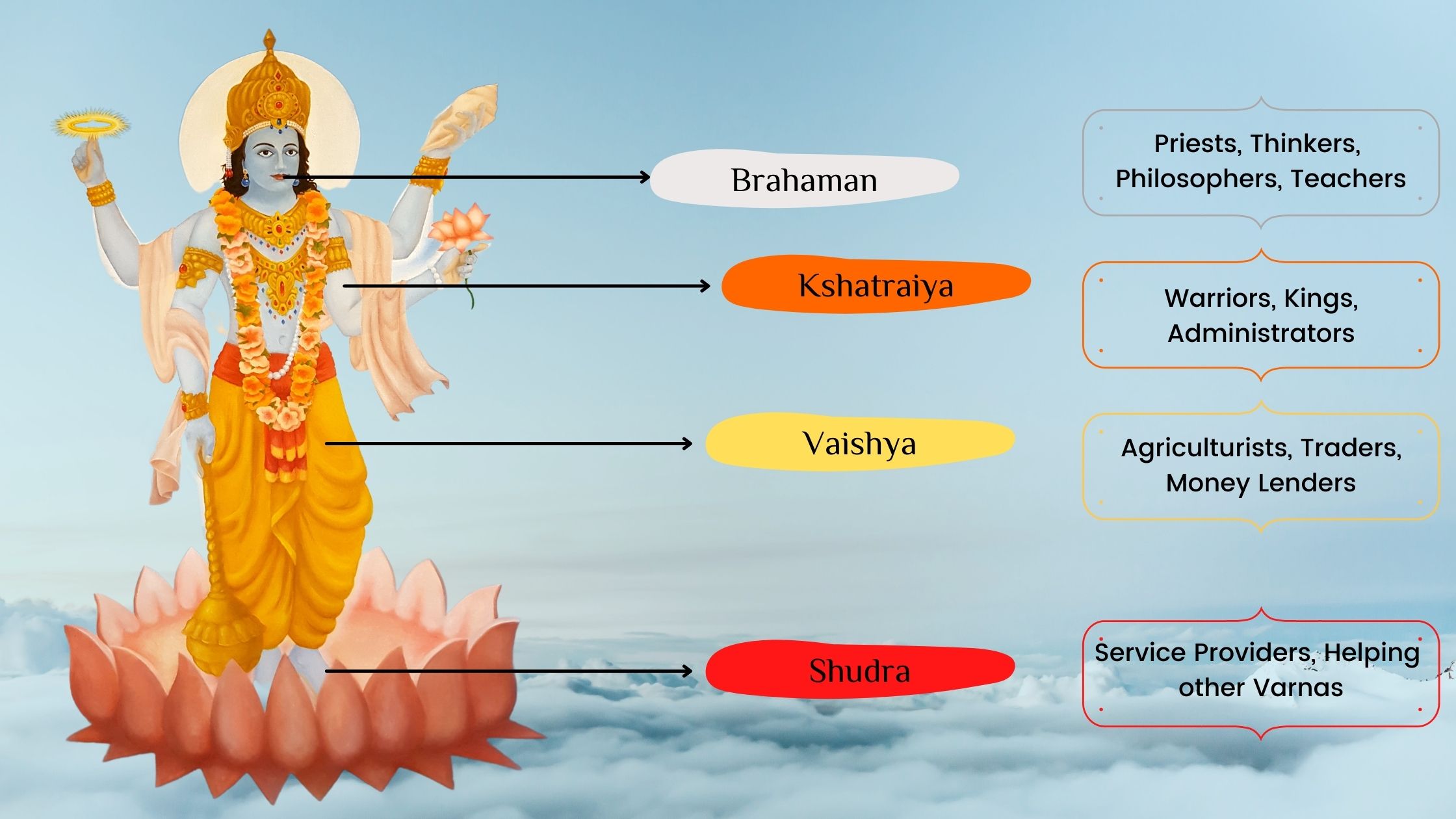
The Varna System was an ancient Indian framework that categorized society into four main groups based on duties and qualities. Deeply tied to religion, education, and social responsibilities, it shaped the foundation of traditional Indian society.
🕉️ The Varna System: A Deep Dive into Ancient Indian Social Order
📜 Introduction
The Varna System was one of the earliest frameworks of social classification found in ancient India, with its roots going back to the Rigveda, one of the oldest scriptures of Hinduism. While initially meant as a functional division of labor, over time it evolved into a rigid hierarchical system that has both shaped and challenged Indian society for millennia.
🧱 Origin of the Varna System
🔹 Vedic Roots
The concept of Varna is first mentioned in the Rigveda (c. 1500 BCE), especially in the Purusha Sukta (10.90). According to the hymn, society was created from the body of the cosmic being, Purusha:
Brahmins came from the mouth (speech, wisdom)
Kshatriyas from the arms (strength, protection)
Vaishyas from the thighs (commerce, sustenance)
Shudras from the feet (service, labor)
🔹 Meaning of “Varna”
The Sanskrit word "Varna" means color, but metaphorically, it signifies type, order, or class. It originally referred to qualities and professions, not birth-based hierarchy.
🧩 The Four Varnas Explained
1. Brahmins – The Priestly Class
Role: Scholars, teachers, and priests.
Duties: Performing rituals, preserving sacred texts (Vedas), teaching.
Lifestyle: Expected to lead austere, disciplined lives focused on jnana (knowledge) and dharma (duty).
🧠 They were the intellectual and spiritual guides of society.
2. Kshatriyas – The Warrior Class
Role: Kings, soldiers, administrators.
Duties: Protecting the realm, upholding justice, governing.
Lifestyle: Trained in warfare, leadership, and administration.
⚔️ Kshatriyas were seen as society’s protectors and rulers.
3. Vaishyas – The Merchant Class
Role: Farmers, traders, artisans.
Duties: Managing agriculture, trade, and wealth.
Lifestyle: Focused on economic activities and community welfare.
💰 Vaishyas were the economic backbone of the community.
4. Shudras – The Laboring Class
Role: Servants, manual laborers.
Duties: Supporting the other three varnas through labor and service.
Lifestyle: Often excluded from religious education and privileges.
🛠️ Though essential, they were assigned the lowest status in this hierarchy.
⚖️ Varna vs. Jati: Understanding the Confusion
Varna = Theoretical classification into 4 categories (based on guna and karma).
Jati = Thousands of birth-based sub-castes based on occupation and region.
While varna was ideally fluid, jati was rigid and became the basis of caste-based discrimination.
🧬 Flexibility in Ancient Times
In early Vedic times:
A person’s varna was determined by qualities (guna) and deeds (karma), not by birth.
Examples in epics: Valmiki (a sage, born from a hunter caste), Vyasa (author of Mahabharata, born to a fisherwoman).
Social mobility was possible, though not common.
⛓️ Degeneration into Casteism
Over centuries, particularly during the later Vedic and post-Vedic periods:
The varna system hardened into a hereditary caste system.
Inter-varna movement was discouraged.
Untouchability emerged for those outside the system (e.g., Dalits).
What began as a functional classification turned into rigid social hierarchy, fueling inequality.
🧘♂️ Philosophical Interpretations
🔹 Bhagavad Gita (Chapter 4, Verse 13):
"Chaturvarnyam maya srishtam guna-karma-vibhagashah"
("The fourfold order was created by Me according to qualities and work.")
Krishna emphasizes merit-based classification, not birth.
This suggests the original idea was dynamic and meritocratic.
🏛️ Varna System in Ancient Literature
Manusmriti: Codified varna-based duties, often with strict, patriarchal overtones.
Dharmashastras: Prescribed rules for each varna and their interactions.
Epics like Mahabharata and Ramayana depict both idealized and flawed views of varna roles.
⚔️ Resistance and Reform Movements
Throughout history, thinkers challenged the rigid varna/caste system:
🔹 Buddha & Mahavira
Denounced birth-based varna.
Advocated universal spiritual liberation.
🔹 Bhakti & Sufi Saints
Emphasized equality before God (e.g., Kabir, Ravidas).
🔹 Modern Reformers
Dr. B.R. Ambedkar: Fierce critic; led the fight for Dalit rights.
Mahatma Gandhi: Aimed to reform casteism, although criticized for supporting the idea of ‘varna’ in theory.
🏛️ Present-Day Relevance
The Indian Constitution (1950) abolished untouchability and promoted equality.
Caste-based reservations (affirmative action) aim to uplift historically disadvantaged groups.
Yet, caste identities persist, especially in marriage, politics, and rural economies.
The Varna system still casts a long shadow—socially, politically, and psychologically.
🧠 Humanizing the Debate
To truly understand the Varna system, one must:
See it as a complex socio-cultural phenomenon.
Acknowledge both its original idealism and its historic distortions.
Listen to the lived experiences of those affected, especially from oppressed communities.
📚 Conclusion
The Varna system was never just a list of jobs. It was a living structure that evolved, decayed, and now continues to influence Indian society in subtle and overt ways. Reform and reflection are needed—not just to change laws, but to change hearts and minds.
✅ Multiple Choice Questions (MCQs)
1. The Varna system was first mentioned in:
A. Manusmriti
B. Arthashastra
C. Rigveda
D. Mahabharata
Answer: C. Rigveda
2. In the Varna system, Kshatriyas were responsible for:
A. Rituals and prayer
B. Trade and commerce
C. Warfare and governance
D. Manual labor
Answer: C. Warfare and governance
3. According to the Bhagavad Gita, varna was based on:
A. Birth
B. Skin color
C. Wealth
D. Qualities and karma
Answer: D. Qualities and karma
4. The term 'varna' literally means:
A. Occupation
B. Division
C. Color
D. Duty
Answer: C. Color
5. Who among the following was a major critic of caste-based discrimination in modern India?
A. Ashoka
B. Swami Vivekananda
C. Dr. B.R. Ambedkar
D. Tulsidas
Answer: C. Dr. B.R. Ambedkar
🧠 UPSC-Level Questions
1. Essay Question (GS Paper 1 – Society):
Critically examine the evolution of the Varna system from a functional social order to a rigid caste-based hierarchy. How has this transformation impacted Indian society historically and in contemporary times?
2. GS Mains – Ethics (Paper 4):
The Varna system was originally merit-based but later became exclusionary. Discuss the ethical dimensions of social stratification and the role of public policy in addressing historical injustices.
3. GS Prelims Practice:
Consider the following statements:
The Varna system was rigid and hereditary from the beginning.
Manusmriti legitimized caste-based hierarchy.
Buddha supported the Varna system.
Which of the above statements is/are correct?
A. 1 and 2
B. 2 only
C. 2 and 3
D. 1, 2, and 3
Answer: B. 2 only
11-Jul-2025 02:29 PM
Explore the fascinating structure, origin, and dynamics of our Earth—from...
11-Jul-2025 02:18 PM
Understand the vital role of lysosomes and cellular transmission in...
11-Jul-2025 01:48 PM
A concise and exam-focused overview of Plasmolysis and Protoplasm, covering...
04-Jul-2025 12:46 PM
India’s education system is undergoing a major transformation to prepare...
02-Jul-2025 02:51 PM
Recent research suggests that the transfer of genes between fungi...



Leave a Comment