Explore the fascinating structure, origin, and dynamics of our Earth—from its formation to its layered interior, rotation, and life-supporting features. This beginner-friendly yet UPSC-relevant blog covers everything you need to know about our planet in a clear, humanized way.
Our Earth – The Living Planet
The Earth is more than just a mass of rock floating in space—it's a complex, vibrant, and dynamic system that supports life as we know it. From the solid crust we walk on to the air we breathe and the water we drink, every part of Earth is intricately connected. In this blog, we’ll break down the components of our planet, how it evolved, and why understanding it is crucial—not only for science lovers but also for UPSC aspirants seeking to connect concepts across geography, environment, and current affairs.
Origin of the Earth
➤ The Big Bang to Blue Planet
The universe began around 13.8 billion years ago with the Big Bang.
Earth formed about 4.6 billion years ago from the debris of a rotating cloud of gas and dust, known as the solar nebula.
Gravity pulled this material together to form the Sun and its planets—Earth being the third from the Sun.
➤ Formation Timeline
Accretion Phase: Dust particles collided and stuck together.
Differentiation: Heavier elements sank to the center (iron and nickel), forming the core; lighter ones formed the crust and atmosphere.
Cooling & Solidification: Surface began to cool and harden.
Atmosphere & Oceans: Gases like CO₂, methane, and water vapor formed a primitive atmosphere, and later, rain created oceans.
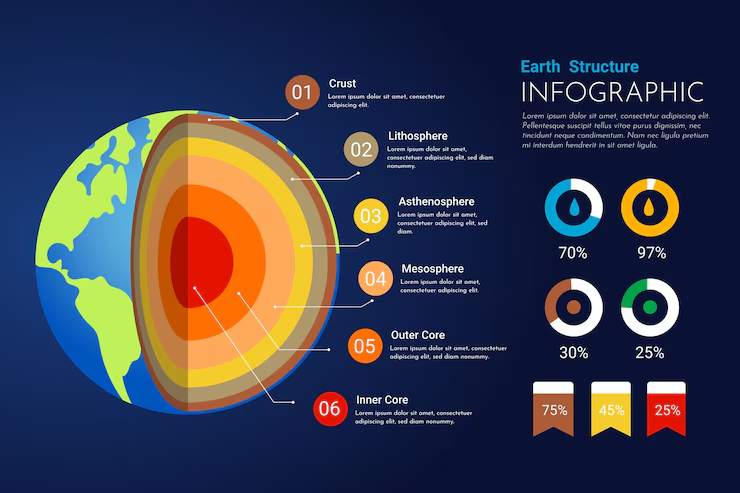
Structure of the Earth
The Earth is like a layered onion, with each layer playing a unique role.
➤ Crust
Outermost solid layer (5–70 km thick).
Composed of continental crust (granitic) and oceanic crust (basaltic).
Broken into tectonic plates.
➤ Mantle
Located below the crust (~2,900 km thick).
Semi-solid, rich in silicates, magnesium, and iron.
Convection currents here cause plate movements.
➤ Core
Divided into:
Outer core (liquid, iron-nickel, generates magnetic field).
Inner core (solid due to immense pressure).
Earth’s Unique Features
➤ Life-Supporting Atmosphere
Composed of nitrogen (78%), oxygen (21%), CO₂, and other gases.
Protects us from harmful ultraviolet radiation and regulates temperature.
➤ Water – The Blue Planet
About 71% of Earth's surface is covered with water.
Presence of liquid water in all three states (solid, liquid, gas) makes Earth unique.
➤ Plate Tectonics
Responsible for earthquakes, volcanoes, mountain-building.
Helped create diverse landforms and ecosystems over time.
Earth's Motions
➤ Rotation
Earth rotates on its axis every 24 hours, causing day and night.
Axis tilted at 23.5°, responsible for seasons.
➤ Revolution
Earth revolves around the Sun in 365.25 days, causing annual seasons.
The elliptical orbit also affects the duration of seasons slightly.
Earth and the Sun – The Energy Relationship
The Sun is Earth’s primary energy source.
Solar energy drives weather, photosynthesis, and climate systems.
Earth’s distance from the Sun (approx. 150 million km) makes it neither too hot nor too cold—perfect for life (Goldilocks zone).
Biosphere – Earth’s Living Skin
Includes all life forms and the environments they live in.
Interacts with lithosphere (land), atmosphere (air), and hydrosphere (water).
Human activities, like deforestation and pollution, disturb this balance—leading to issues like climate change.
Dynamic Earth: Natural Phenomena
➤ Earthquakes
Caused by plate movement.
Measured on the Richter scale.
➤ Volcanoes
Eruption of molten lava from Earth’s crust.
Can be destructive but also create fertile soil.
➤ Tsunamis
Giant ocean waves caused by undersea earthquakes.
These phenomena remind us that Earth is alive and always changing.
Conservation of Earth
As humans, our relationship with Earth is one of dependence—but also responsibility.
Pollution, overpopulation, and overexploitation of resources are endangering Earth's systems.
Initiatives like climate action, renewable energy, afforestation, and sustainable development are key to safeguarding our planet.
MCQs with Answers and Explanations
1. What is the approximate age of the Earth?
A) 2.5 billion years
B) 4.6 billion years
C) 6.4 billion years
D) 3.2 billion years
✅ Answer: B
Explanation: Earth formed around 4.6 billion years ago from solar nebula.
2. Which layer of the Earth is responsible for the generation of magnetic field?
A) Crust
B) Mantle
C) Outer Core
D) Inner Core
✅ Answer: C
Explanation: The movement of molten iron in the outer core generates Earth’s magnetic field.
3. The axis of the Earth is tilted at:
A) 90°
B) 45°
C) 23.5°
D) 66.5°
✅ Answer: C
Explanation: The Earth's tilt causes seasons.
4. Which of the following is not part of Earth’s interior layers?
A) Crust
B) Mantle
C) Lithosphere
D) Core
✅ Answer: C
Explanation: Lithosphere includes the crust and upper mantle; it is not a separate interior layer.
UPSC-Level Conceptual & Application-Based Questions
1. Consider the following statements:
The Earth’s magnetic field is generated in the inner core.
Continental crust is denser than oceanic crust.
The Earth’s rotation affects wind direction.
Which of the above are correct?
A) 1 and 2 only
B) 2 and 3 only
C) 3 only
D) 1, 2, and 3
✅ Answer: C
Explanation:
Magnetic field is generated in the outer core, not inner.
Continental crust is less dense than oceanic crust.
Earth's rotation influences Coriolis effect, affecting wind patterns.
2. Why does the presence of water in all three states make Earth unique in the solar system?
A) It helps Earth reflect sunlight
B) It supports greenhouse effect
C) It allows diverse life forms to thrive
D) It forms the ozone layer
✅ Answer: C
Explanation: Earth’s water in liquid, solid, and gaseous states helps maintain life-supporting conditions.
3. How does plate tectonics contribute to biodiversity on Earth?
A) By altering gene structures
B) By creating uniform environments
C) By reshaping habitats and isolating species
D) By stabilizing climate
✅ Answer: C
Explanation: Tectonic shifts create new landforms and isolate regions, promoting species evolution and diversity.
Conclusion
Our Earth is not just our home—it’s a complex, ever-changing system that has evolved over billions of years. From its fiery origins to the tranquil lakes and forests we cherish today, Earth tells a story of resilience, balance, and interconnection. For UPSC aspirants, knowing Earth isn’t just about answering questions—it's about understanding the planet you plan to serve. By grasping the Earth’s systems, you get a lens to see environmental issues, disaster management, and sustainable policies in a more meaningful way.
11-Jul-2025 02:29 PM
Explore the fascinating structure, origin, and dynamics of our Earth—from...
11-Jul-2025 02:18 PM
Understand the vital role of lysosomes and cellular transmission in...
11-Jul-2025 01:48 PM
A concise and exam-focused overview of Plasmolysis and Protoplasm, covering...
04-Jul-2025 12:46 PM
India’s education system is undergoing a major transformation to prepare...
02-Jul-2025 02:51 PM
Recent research suggests that the transfer of genes between fungi...
11-Jul-2025 01:48 PM
A concise and exam-focused overview of Plasmolysis and Protoplasm, covering...
11-Jul-2025 02:18 PM
Understand the vital role of lysosomes and cellular transmission in...



Leave a Comment