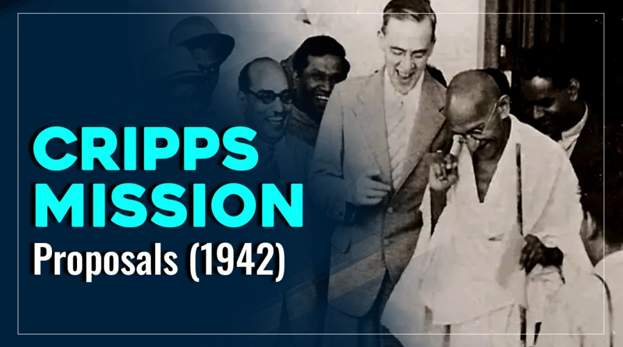
This blog explores the Cripps Mission of 1942, a major political initiative by the British during World War II. It covers its background, main proposals, failure reasons, and long-term implications on the Indian freedom movement. Also includes UPSC-style MCQs and mains-level questions to aid aspirants.
Cripps Mission (1942): A Turning Point in India's Freedom Struggle
🔍 Introduction: Why the Cripps Mission?
The year was 1942. The world was deep into World War II. Britain was struggling to hold back Nazi Germany in Europe and Japanese advances in Asia. In this chaos, the British government desperately needed Indian support. But there was a catch—India was still a colony.
To bridge this growing discontent and avoid rebellion, Britain sent Sir Stafford Cripps to India with a bold offer. This became known as the Cripps Mission.
🏛️ Background: The Political and Global Context
World War II Impact:
Britain was fighting on multiple fronts. Japan had just entered the war and captured parts of Southeast Asia, including Burma (present-day Myanmar), raising fears of a Japanese invasion of India.
Indian Pressure:
Indian leaders were furious. Without consulting them, British India had been dragged into the war. The Indian National Congress, the Muslim League, and even princely states demanded more autonomy.
Growing Unrest:
The August Offer of 1940 had already failed to satisfy nationalist demands. With the threat of revolt growing, Britain realized it needed a new strategy.
👤 Who Was Sir Stafford Cripps?
A senior British politician and a member of the War Cabinet
Known for his leftist views and sympathy toward Indian aspirations
Sent by Prime Minister Winston Churchill to negotiate a constitutional settlement with Indian leaders
Cripps had credibility, but also limits. He couldn’t negotiate complete independence—only offer post-war promises.
📜 Main Proposals of the Cripps Mission
Dominion Status After the War:
India would become a Dominion—a self-governing entity under the British Commonwealth.
Constituent Assembly:
A body would be created after the war to draft a new Constitution of India. Members would be elected by provincial assemblies and nominated from princely states.
Right to Secede:
Any province or princely state that didn’t want to join the Indian Union could opt out and form its own union or stay separate.
Interim Government During War:
India would be governed by an Executive Council, including Indian leaders, but the British Governor-General would retain veto powers.
Safeguards for Minorities:
Special provisions would be made for minorities, especially Muslims and princely states.
❌ Why Did the Cripps Mission Fail?
1. Indian National Congress' Objections:
Congress wanted complete independence, not just dominion status.
It rejected the idea of provinces being allowed to opt out, fearing it would lead to partition.
Gandhi famously called it a “post-dated cheque on a crashing bank.”
2. Muslim League’s Objections:
The League, led by Muhammad Ali Jinnah, was upset that Pakistan was not directly acknowledged.
They wanted a separate Muslim nation, which wasn’t explicitly promised.
3. British Reluctance:
Churchill and other leaders had no real intention of handing over power before the war ended.
Cripps was not given full negotiating authority, leading to deadlock.
📌 Key Outcomes and Significance
1. Triggered the Quit India Movement:
The failure of the Cripps Mission led Gandhi and the Congress to launch the Quit India Movement in August 1942.
It was a massive civil disobedience movement and arguably the final major push for independence.
2. Laid the Foundation for Future Negotiations:
Although it failed, the mission showed the seriousness of Indian demands and internationalized the Indian question.
3. Exposed Internal Divisions:
The differences between Congress, the Muslim League, and the British became more visible.
It revealed the growing demand for Pakistan and hinted at the partition of India.
🧠 Humanizing the Story: Cripps and Gandhi’s Meeting
Gandhi was unimpressed with Cripps. Their meetings were cordial but fruitless.
Cripps, frustrated, once remarked:
"I could not get a yes or no from him.”
Gandhi quipped back:
"You’re asking us to accept slavery today with a promise of freedom tomorrow."
This exchange reflected the mistrust and political fatigue on both sides.
🧾 Cripps Mission Timeline
📊 UPSC-Relevant Analysis
🧩 UPSC-Level MCQs with Answers
Q1. Who led the Cripps Mission to India in 1942?
A. Clement Attlee
B. Stafford Cripps
C. Lord Wavell
D. Winston Churchill
✅ Answer: B. Stafford Cripps
Q2. Which of the following was NOT a proposal of the Cripps Mission?
A. Dominion Status
B. Formation of Constituent Assembly
C. Immediate Indian Independence
D. Right of provinces to opt out
✅ Answer: C. Immediate Indian Independence
Q3. Gandhi described the Cripps Offer as:
A. “A golden opportunity”
B. “The first real step towards freedom”
C. “Post-dated cheque on a crashing bank”
D. “Constitutional fraud”
✅ Answer: C. “Post-dated cheque on a crashing bank”
🧪 UPSC Mains-Level Questions
1. Discuss the reasons for the failure of the Cripps Mission. What were its long-term implications on India’s independence struggle? (250 words)
2. Critically evaluate the significance of the Cripps Mission in the context of World War II and Indian national movement.
🧷 Conclusion
The Cripps Mission was a moment of lost opportunity and rising discontent. While it failed politically, it lit the final spark for India’s complete freedom movement. For UPSC aspirants, it stands as a powerful case study of negotiation, nationalism, and colonial resistance.
11-Jul-2025 02:29 PM
Explore the fascinating structure, origin, and dynamics of our Earth—from...
11-Jul-2025 02:18 PM
Understand the vital role of lysosomes and cellular transmission in...
11-Jul-2025 01:48 PM
A concise and exam-focused overview of Plasmolysis and Protoplasm, covering...
04-Jul-2025 12:46 PM
India’s education system is undergoing a major transformation to prepare...
02-Jul-2025 02:51 PM
Recent research suggests that the transfer of genes between fungi...


Leave a Comment